Wednesday, June 26, 2019

A Historical Survey of Four Different Aspects of Universal Equality

Universal equality has several different aspects. It can be arrived at as an ethical concept, an affirmation of our humanity and a moral vision of the world in which we live, from several different directions. This is because there are several different aspects of human nature and several different perspectives of the world in which we live. It is the several aspects of universal equality, however, that make it an accommodating or unifying moral foundation of government in a pluralist society.

Before developing an analytical framework for moral and political philosophy, it will be helpful, as a point of reference, to look at four different aspects of universal equality in the historical context of four different ethical and legal systems. Within Western civilization there developed several sources of moral authority for law and several corresponding ethical and legal systems. Canon Law, Roman Law, English common law, and the social contract theory associated with constitutional law each had a different primary source of moral authority. Each of these systems of law was, consequently, based on a different type of ethical system, and each focused primarily on a different facet of human nature. Constitutional democracy integrates aspects of these four ethical and legal systems as they relate to universal equality and the coercive powers of government.

“It is the several aspects of universal equality that make it an accommodating or unifying moral foundation of government in a pluralist society. ”

Judeo - Christian and Canon Law, for example, was based on the authority of God and related primarily to what it understood to be the soul of man. Its ethic is deontological, deon meaning “duty” in Greek. That is, it is based on a universal duty “to love God with all thy heart, and with all thy soul, and with all thy strength, and with all thy mind; and thy neighbor as thyself” (Lev 19:18, Deut 6:5, Lk 10:27, Mk 12:29–31). Canon Law contains universal ethical principles based on a reverence for God and reciprocity towards one’s fellow man. The equal dignity and worth of all persons in this religious system derives from a belief that God not only created humanity, but that man and woman were also made in God’s image (Gen 1:27). Equality is intrinsic and not derived from one’s individual attributes, but from the relationship between God and humanity.

Roman Law, on the other hand, incorporated significant aspects of natural law based on the authority of a perceived natural moral order in the universe. Such a natural moral order could be understood by all persons, it was believed, because all humans share a capacity for right reason, an ability to know right from wrong. All of the various people within the vast Roman empire, for example, could be expected to learn and know that is wrong to steal. The ethical system of natural law is primarily normative (based on norms or ideals). Universal equality in classical civilization is based on all human beings having a capacity for right reason and also on a concept of reversibility which requires a rational imagination and empathy.

Aristotle, in his Poetics, described reversibility as one of two major elements in Greek tragedies. The second element is catharsis, part of which is a realization that we all, even heroes and kings, have character flaws and are also subject to fate, both of which can lead to a reversal of fortunes. An ethic based on reversibility is not just classical.. In the first century, Rabbi Hillel taught, “What is hateful to thyself do not do to another. This is the whole Law, the rest is commentary” (Shab. 31a). It is also the basis, however, of the Kantian categorical imperative that one cannot place oneself outside of morality without implicity permitting others to do the same. Reversibility was also a primary moral reason in the thought of both Jefferson and Lincoln in their opposition to slavery (Basler 1953, vol. II, 532; Jefferson [1785] 1972, 163). The more recent concept of John Rawls in A Theory of Justice (1971) of justice as fairness, with an original position in which one does not know either his or her fate or circumstances in life’s game, is an extension of the concept of reversibility.

Common law in English feudal society derived its moral authority from yet another source—not from God or nature, but from social custom and tradition. This was primarily a communitarian ethical system. It related to the social conscience of the people based on their ethical concepts of rights and responsibilities in society. Traditional English rights pro- gressively became a basis of communal solidarity.

Finally, the social contract theory associated with constitutional law derives its moral authority beginning with the individual in a state of nature concerned primarily about his own safety and happiness. Its very premise is not only that all are free and equal in a state of nature but that everyone is also endowed with natural rights which they are entitled to defend. Such a theory is based on individual concerns and contract. The universality of social contract theory as it applies to democratic processes and constitutional law, however, makes it essentially a humanitarian ethic. It contains an ethic of universal equality based on what we now refer to as human rights and a just claim to resist the violation of those rights.

American constitutional democracy integrates and balances these four ethical systems as they apply to the several aspects of universal equality and the coercive powers of government. The accommodating common moral concept is not just a deontological ethic, with concepts of reverence and reciprocity, relating to God and a person’s soul; nor is it just a normative ethic based on concepts of right reason and reversibility, relating to a perceived moral order in nature and our capacity to understand that order with our reason; nor is it just a communitarian ethic, with concepts of social rights and responsibilities, as they relate to the several aspects of society and our social conscience; nor is it only a humanitarian ethic, with a concept of human rights and the right to resist tyranny, relating to our individual lives and our fundamental needs and desires. The accommodating or unifying moral concept is universal equality which can be derived analytically, and has been derived historically, from each of these sources of authority and aspects of human nature.


Open Access also at moralfoundations.com

Why Ideas and Values are Important Now

“The adaptations needed for living in a pluralistic global community without coercion or alienation or self-destruction will have to be cultural.”


We now live in a pluralistic global community that has access to or potential access to weapons of mass destruction. Ever since WW II there has been a concern that our technological advances may exceed the ability of our adaptive biological and cultural moral capacities to control that technology. In evolutionary theory, this possibility of humanity’s self destruction is called the “nuclear trap.” For more than 30 years the United States and the Soviet Union had military defense policies based on the threat of mutual assured destruction. Response times to a nuclear threat are measured in minutes. Coercive power thus reaches a level of absurdity in which it cannot be used without not only self-destruction, but the destruction of most of the foundations of life on earth. Today we are faced with more than the traditional conflicting super powers and ideologies. We also have a megalomaniac tyrant in North Korea who threatens the use of nuclear weapons, a sectarian Iranian government with an apocalyptic eschatology that both supports terrorism and is trying to develop nuclear weapons, and cults of radical Islamic terrorists who have the objective of destroying Western civilization. Probably the greatest issue of our times is the need to create a more stable world order.


"All men are created equal"
The adaptations needed for living in a pluralistic global community without coercion or alienation or self-destruction will have to be cultural. We have the historical cultural resources which transcend a narrow tribalism to include also universal values and affirm a respect for personal dignity and our common humanity. Yet in the current context of such atrocities as beheadings, burning or drowning of men in cages, the abduction of young girls into sexual slavery, ethnic cleansing, the genocide of minority groups in the Middle East, and a resurgence of autocratic governments, we are failing to adequately defend and promote those values in what is very much a battle of ideas. There are several cultural trends which have contributed to this failure:
  1. Legal Positivism. Legal positivism, for example, has been the prevailing legal philosophy in our law schools for several decades. It is the position of legal positivism that there are no universal laws or for that matter any universal morality. Legal positivism contends that from a historical and global perspective, laws and morality are only relative. There are no universal values such as human rights. Legal positivism is thus disarmed in the current battle of ideas. If everything is relative, then there is no foundation for criticizing or opposing the atrocities of the 20th Century or today. Most of our leaders have been trained in law school. Legal positivism, however, is only descriptive and not prescriptive. I am a physician and from a physician’s perspective, medical ethics are based on a respect for personal dignity and our common humanity. If there is to be generational survival and well-being, then there is the need for moral constraint. In this context the natural law perspectives in political philosophy and jurisprudence, whether they be secular as in Roman Law which was based on reason, or religious as in Judeo-Christian history, can be seen as an adaptation to reality. There is huge advantage to cooperation. It is what has made humanity successful. Cooperation requires community. To live in a community requires some moral constraint.
  2. Capital Punishment. It is harder for the United States to be a leader in creating a more stable and less violent world order when we still choose to continue capital punishment executions and there is a viable option of a life sentence without parole.
  3. Abolishing the death penalty would be a step forward in helping us to both understand and to convey that equality, understood as a respect for personal dignity and our common humanity, is the primary moral concept of United States constitutional democracy.
  4. An academic culture of “blame America first” This is a residual from the 60’s and the protests against the Vietnam War which has persisted as a matter of affirmation in our universities. As just one example, I have given papers at many international conferences and I am embarrassed to say that the most anti-American presentations are given by American professors.
  5. An emphasis on diversity rather than what we share in common. Our common values have been undermined in part by a postmodern individualism in which, in the words of Woody Allen, “the artist creates his own moral universe.” What we share in common has also, however, been obscured by an emphasis on a politics of group identity and diversity. It also could have been pointed out in the discussions about American exceptionalism that from a historical point of view America was exceptional in that the free and equal individual became the basis of our communal solidarity rather than any particular type of nationalism based on ethnicity, language, or religion.
  6. An Orwellian political parsing and spin on language. As George Orwell observed, totalitarian regimes often distort and invert the truth by corrupting the meaning of words and language. For example, totalitarian communist regimes have, at least in theory, advocated equality as the common ownership of the means of production, but have actually denied political equality as well as the moral agency of other people. In academics there has also been a trend of deconstructing language such that one can say that an explanation depends upon “What the meaning of is, is.” President Obama couldn’t bring himself to even use the words “radical Islamic terrorism” even when ISIL describes itself as a fundamentalist Islamic group that uses terror. A major conflict in international affairs, however, has been between moderate Muslims and radical Muslims, with the radical Muslims being defined as those who are willing to commit atrocities based on religion, including the killing of moderate Muslims, as a means to their ends. The American public is capable of making this distinction and not to make this distinction in realistic terms attempts to ignore the problem of a radical Islamic ideology.
  7. Equality as the primary moral concept. There is a lack of understanding and thus difficulty in conveying that the primary moral concept of our government is equality, understood as a respect for personal dignity and our common humanity. The origins of the several moral concepts of equality in the Western legal tradition are also not appreciated.

The Importance of Ideas and Values in Foreign Policy

At the time of a clash of civilizations it is not unusual for both sides to re-examine, define, and even sometimes codify their basic values and cultural institutions in order to both preserve and convey their basic values and traditions. At the time of the fall of communism in the Soviet Union and in Eastern Europe, the United States did this poorly. We have made a similar mistake in our war against terrorism, which is very much a battle of ideas and ideologies and will have to be understood as such for any chance of a long-term resolution and reconciliation. The values of freedom, equality and human rights in the Western liberal tradition are now also being challenged by the autocratic regimes of China, Russia, and Iran and their proxies in North Korea, Syria, and Venezuela. Our response of economic and military nationalism may be necessary and pragmatic, but we should also do more to describe, defend, and convey our values.

We have thus been missing a defining opportunities in the history of the moral and political philosophy of the liberal tradition; first, by not defining our primary moral value as equality, understood as a respect for the dignity and worth of our common humanity; and second, by not defining our government as a constitutional democracy, which is the only way to convey both the substantive and the procedural concepts of equality that it incorporates.

First, at the time of the fall of communism, the media, the academics, and our government almost universally described the United States as a capitalist democracy. This was in part because we allowed the Soviet Union to describe their communism to be primarily an economic system rather than a totalitarian political system, which denied any concept of moral or political equality. The primary alternative to communism should have been constitutional democracy. It is the constitutional aspects of our government, such as the Bill of Rights, that incorporate our substantive concepts of equality. These constitutional principles are placed beyond the usual majority rule of the legislative process. It is the democratic aspects of our government that incorporate the procedural aspects of equality, such as “one person, one vote.”


Bill of Rights

Second, after the events of September 11, 2001, there was seldom a mention of our primary moral concept of equality. The terrorist attack of 9/ ll was an attack on both our freedom and security and it is perhaps understandable that our values have thus been described primarily in those terms. In the Declaration of Independence, however, the first premise was that “all men are created equal” and that put everything that followed, including life, liberty and the pursuit of happiness, in a moral context. Even the great reformers, such as the women suffragettes and the Rev. Martin Luther King, Jr. did not repudiate these principles, but urged us to live up to them and place them into practice.

Donald Rumsfeld, the former Secretary of Defense, was asked how the United States was faring against the extremist ideology in the global “battle of ideas.” He said, “If I were grading, I would say that we probably deserve a D+ as a country.” We are indeed in a “battle of ideas”, in part, with a radical version of Islam. Islam, the religion of 1.2 billion people, is based on a submission to the will of God. Much of the liberty that we convey, on the other hand, is seen by others as the self-indulgence of our culture. We also unnecessarily lost much of the moral high ground with our initial waffling on the issues of torture and human rights.

During the current war on terrorism it may be appropriate that we emphasize freedom. To achieve our objectives we will also need the cooperation of many countries that are not constitutional democracies. To win the peace, however, we will need to understand and convey that our primary moral value is universal equality, understood as a respect for an inherent personal dignity and our common humanity.

Third, there is now a de facto collaboration of autocratic regimes to replace the current world order based on the Western liberal tradition. The Preamble to the United Nations Declaration of Human Rights begins by stating “Whereas recognition of the inherent dignity and of the equal and inalienable rights of all members of the human family is the foundation of freedom, justice and peace in the world,” The Ideas and values of the Western liberal tradition should thus play an important role in foreign policy. This is important, for It is the recognition of personal dignity and our common humanity in a pluralistic world that makes the accommodation of a wide variety of attributes, cultural differences, desires, and beliefs possible without the use of coercion or being the cause of alienation.

James H. Rutherford, M.D.

Author of Moral and Political Philosophy

Monday, June 24, 2019

Jefferson and Lincoln on Equality and Slavery as the Tragic Flaw of our Founding

Though one can easily find fault with Jefferson and some of his writings, it is very important to understand that for him the self-evident truth that “all men are created equal” was a universal moral assertion. Jefferson felt that nature was the work of a God who was “Nature’s God,” the Architect, the Creator, the First Cause. Human beings were in this sense created equal. They are also equal he felt in that they are “endowed by their Creator with certain unalienable rights” which include “life, liberty, and the pursuit of happiness.” Indeed, it was to secure these rights associated with the moral assertion of universal equality that “Governments are instituted amongst men, deriving their just powers from the consent of the governed.” The Declaration of Independence is argued in the manner of Euclidean geometry. It is also significant to note in this context that, unlike Locke, Jefferson did not include the right to property (which at the time would have included slaves) in his first principles or axioms.

More specifically, Jefferson felt that we all share equally a common humanity in that we have a capacity for, and possess, a moral sense (Padover 1943, 1032–34). In a letter to his young friend Peter Carr, Jefferson wrote:
He who made us would have been a pitiful bungler, if he had made the rules of our conduct a matter of science. For one man of science, there are a thousand who are not. What would have become of them? Man was destined for society. His morality, therefore, was to be formed to this object. He was endowed with a sense of right and wrong merely relative to this. This sense is as much a part of his nature, as the sense of hearing, seeing, feeling; it is the true foundation of morality.... The moral sense, or conscience, is as much a part of man as his leg or his arm. It is given to all human beings in a stronger or weaker degree.... It may be strengthened by exercise, as may any particular limb of the body. This sense is submitted, indeed in some degree, to the guidance of reason; butit is a small stock which is required for this; even a less one that what we call Common sense. State a moral case to a ploughman and a professor. The former will decide it as well, and often better than the latter, because he has not been led astray by artificial rules. (Peterson 1977, 424)
Jefferson’s respect for the moral agency of others was indeed an affirmation of his own humanity, a self-affirmation. Concerning women he wrote, “It is civilization alone which replaces women in the enjoyment of their natural equity. That first teaches us to subdue the selfish passions, and to respect those rights in others that we respect in ourselves” (Jefferson [1785] 1972, 60). Jefferson was opposed to religious, political, and social tyranny; thus, equality for him was also a matter of self-assertion. His method of dealing with the will to power of human beings was to invert it to a will to resist the despotism and tyranny of others. In a letter to the physician Benjamin Rush he wrote, “I have sworn upon the altar of God, eternal hostility against every form of tyranny over the mind of men” (Bartlett 1968, 472).


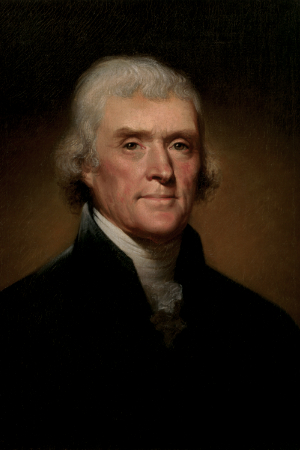
Thomas Jefferson
A universal moral sense or conscience was for Jefferson a basis of our common humanity and natural equality. It was what made persons capable of determining their own form of government by consent. This equality was for Jefferson universal and, yes, it included women, American Indians (Jefferson [1785] 1972, 227), and blacks (Jefferson [1785] 1972, 142). It was a matter of both self-affirmation and self-assertion, and this can help us understand his great concern for religious freedom, public education, and the injustice of slavery.

Slavery was the tragic flaw in the founding of American government. Jefferson was a slaveholder and this cannot be dismissed as only a concession to the society in which he lived. It was in his own self-interest and it allowed him to live an aristocratic lifestyle. He thus contributed to this tragedy. Yet, he understood the moral bankruptcy of slavery, its moral incompatibility with democratic government, and the need for its eventual abolition.

Jefferson felt that slavery could not be immediately abolished without the threat of great violence because of past injustices to blacks and the deeply held prejudices of whites. He had unsuccessfully recommended laws which would have achieved gradual but total emancipation, colonization of gradually emancipated slaves, and exclusion of slavery from all Western Territories (see also Jefferson [1785] 1972, 214). His diatribe against the king for allowing slavery to become established in the colonies was omitted from the final draft of the Declaration of Independence. At the time of the Missouri Compromise of 1820, he described the threat of the slavery issue to the Union as a “firebell in the night,” and he wrote, “we have a wolf by the ears, and we can neither hold him, nor safely let him go. Justice is in the one scale, and self-preservation in the other” (Peterson 1977, 568). More than thirty years earlier he had written, “I tremble for my country when I reflect that God is just; that his justice cannot sleep forever...” (Jefferson [1785] 1972, 163).

Jefferson’s proposal to abolish slavery after 1800 in all territories and future territories was defeated in committee by one vote. Concerning this he later commented: “Thus we see the fate of millions of unborn hanging on the tongue of one man, and heaven was silent in that awful moment” (Kenyon 1980). Jefferson understood the moral dimensions of freedom and he put them forth in stating the ideals of a new nation. In practice, the Civil War with the loss of over 600,000 lives and several constitutional amendments were necessary to both preserve the Union and make universal equality as a principle and as the basis of the democratic process something toward a reality.


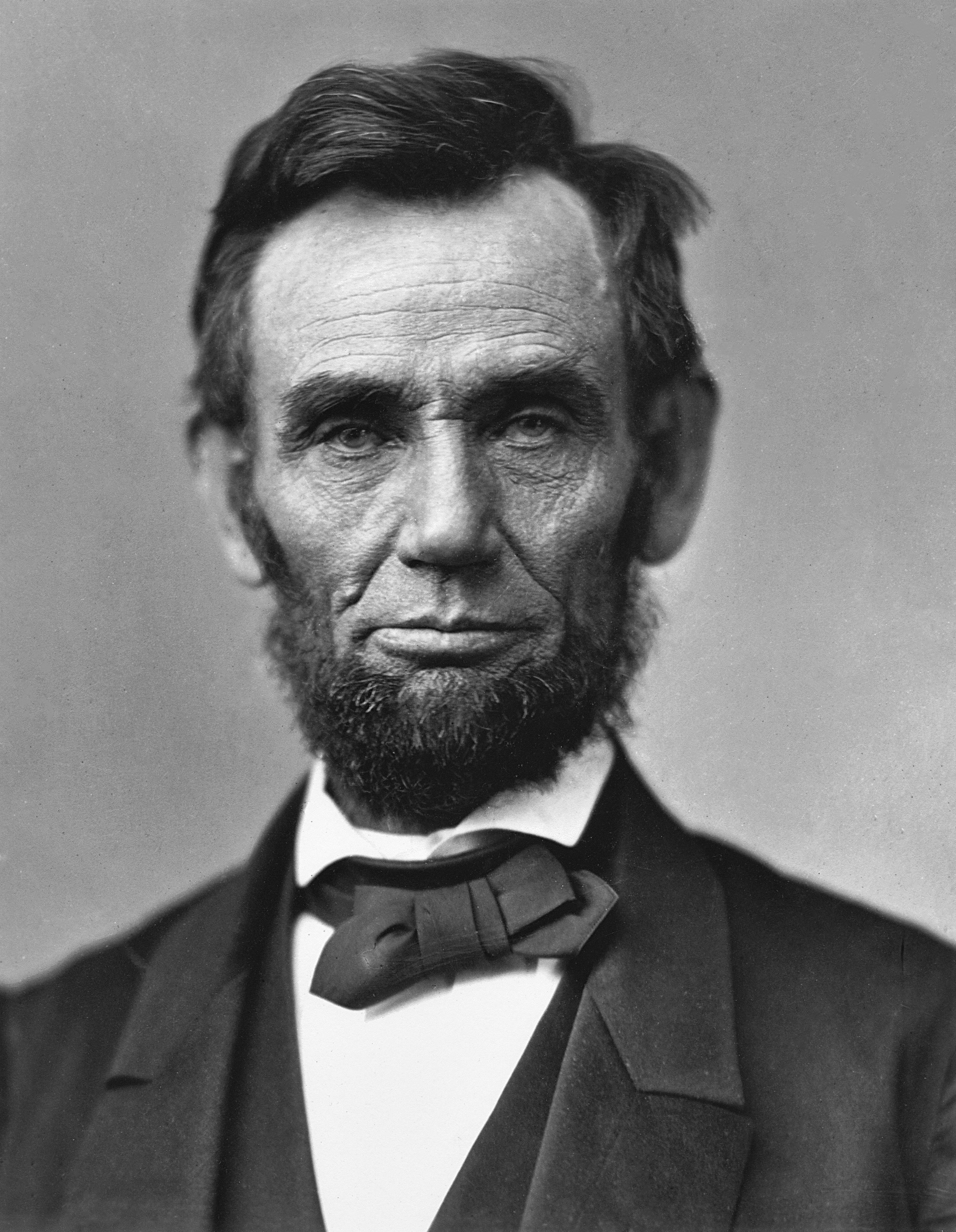
Abraham Lincoln
Lincoln never wavered in his assertion that slavery was morally wrong and he opposed its extension into the territories. He also opposed resolving the issue of slavery in the territories, as Senator Douglas had proposed, by making it a matter of local popular sovereignty. Yet, he initially fought,and probably could not have otherwise won, the Civil War on the issue of national sovereignty and preservation of the Union. To preserve the Union, Lincoln needed both public opinion and the slaveholding border states of Missouri, Kentucky, Maryland, and Delaware. Lincoln tried to uphold both the ideal in the Declaration of Independence of “a new nation, conceived in Liberty, and dedicated to the proposition that all men are created equal” and the rule of law in the Constitution of “government of the people, by the people, for the people.”Lincoln realized, however, that public opinion was needed to bring the ideals of universal equality into practice in a democratic republic.

Complete Essay with references from my book, Moral and Political Philosophy.

James Ruthereford, M.D.

Equality as the Primary Moral Concept of American Government

In 1856, before his presidency or the beginning of the Civil War, Abraham Lincoln said:

Our government rests in public opinion. Whoever can change public opinion, can change the government, practically just so much. Public opinion, or [on?] any subject, always has a “central idea,” from which all its minor thoughts radiate. That “central idea” in our political public opinion, at the beginning was, and until recently has continued to be, “the equality of men.” (Basler 1953, vol. II, 385; see also Jaffa 1982, chap. XIV).

Many would consider liberty, or freedom, to be the fundamental moral concept on which our government was founded. Freedom, however, has little meaning outside of one’s moral concept of justice.


“It is indeed the self-imposed ethical or moral foundations of government that change mere obedience to the coercive powers of government into a sense of consensual responsibility for a moral duty, a just order, the common good, or human rights. ”

Freedom can mean, simply license, the absence of any social obligation or moral constraint. Being a free moral agent does not necessarily mean that one will choose to be moral. Freedom does not address the need to maintain order, establish justice, or provide for the general welfare. Nor does freedom provide much protection from the coercive powers of government unless it means “liberty for all” (Basler 1953, vol. IV, 168–69). Indeed, what we often desire is freedom from the arbitrary will of others.

When Jefferson put forth the ideals of our country in the Declaration of Independence, his first assertion, his primary self-evident truth, was that “all men are created equal.” The unalienable rights of life, liberty, and the pursuit of happiness were thus put within an ethical context of equality and reciprocity. Jefferson and Lincoln both understood universal equality to be the primary moral concept of American constitutional democracy.

Others have also understood universal equality to be the primary moral concept. Marvin Meyers in his book on James Madison, The Mind of the Founder, concluded that, “in Madison’s view of man,” equality was the fundamental term (1981, xxii). Alexis de Tocqueville, in Democracy in America (1835–1840), “advanced the influential thesis that equality is the fundamental theme and characteristic of American civilization” (Davis 1990, 11).

Alexis de Tocqueville


Tocqueville noted that even tyrants value freedom, but only for themselves. He also understood that equality is not an extrinsic leveling term but conveys an inherent mutual respect which also implies an equality of political freedom. David Brion Davis, a prominent historian of the institution of slavery, has even concluded that the real anthesis of slavery is not freedom but equality (Davis 1990, 29). Even the great reformers, such as the women suffragettes and the Rev. Martin Luther King, Jr., did not repudiate these principles, but urged us to live up to them and place them into practice.

G. K. Chesteron wrote, however, that the belief in human equality is not “some crude fairy tale about all men being equally tall or equally tricky” (see McWilliams 1979,184). It is not like a Procrustean bed of Greek mythology into which all persons are forced to fit by stretching them on a rack or cutting off their legs. For Jefferson, universal equality was instead a moral assertion—an assertion that affirmed both his own humanity and his own individuality against tyranny. Using fable and analogy, in the manner of George Orwell, one could say that if you are a mallard and don’t like ducks or duckhood, then there is going to be an inherent problem with your own self-affirmation by definition. This is one sense in which Jefferson’s assertion that “all men are created equal” could be considered a self-evident truth. It is an affirmation of our own humanity. It is this recognition of his own humanity, however, that allowed Jefferson to also assert his own individuality, not by a “will to power” or coercion, but by inverting that to a resistance to the tyranny of others. By recognizing the moral agency of others, as well as asserting our own mature responsible personality, there opens up the possibility of deciding political issues by the deliberation of democratic constitutional and legislative processes, rather than by simple coercion, domination, or privilege.

The future of American government still rests on public opinion. It rests on our understanding and support for the moral foundations of constitutional democracy and our ability to communicate and preserve such an understand effectively. This is important, for the enjoyment of individual freedom and the progress of human liberty are not inevitable. They are contingent, to a large degree, on our willingness and ability as moral agents to place our free will within ethical constraints. It is indeed the self-imposed ethical or moral foundations of government that change mere obedience to the coercive powers of government into a sense of consensual responsibility for a moral duty, a just order, the common good, or human rights. In United States constitutional democracy these ethical concepts all relate historically to the “central idea” of universal equality.

Complete Essay with references from my book, Moral and Political Philosophy.
James Rutherford, M.D,

The Rallies by the Chinese Residents of Hong Kong Have Given World a Warning.

The goal of President Xi Jinping is not only to make China great again through economic development and a Han Chinese nationalism.  President Xi’s goal is not only to create a Chinese global hegemony based on technology along with economic and military power. The goal of President Xi is also to establish absolute control by the Communist party in China and to replace the current world order based on the Western liberal tradition with a new world order which is safe for autocracies.

Hong Kong was a British colony from 1841 until sovereignty was returned to China in 1997 with an arrangement of “one country, two systems.”  A Basic Law allowed Hong Kong to keep its judicial independence and its own legislature. It also retained its own economic system and the Hong Kong dollar.  Certain human rights, including including freedom of speech and assembly, were protected.

Beijing has now, however, been slowly gaining political control by controlling the nominations process and the election committee for Hong Kong’s chief executive.  The recently proposed extradition law is directed toward criminals that have sought refuge in Hong Kong. There is a concern, however, that it will also exposes anyone in Hong Kong to China’s flawed and political justice system.  It would open the door to Beijing snapping up democracy advocates, dissidents and other critics. The bill would also allow mainland-initiated asset freezes and this has been a concern for Hong Kong’s powerful business community.  

There is also an awareness of Beijing’s hostility to democratic values as described in Docunent 9 from 2013.  This described seven areas which should not be discussed and these include Western constitutional government, universal values, civil society, individual rights, freedom of the press, historical nihilism (discussion of the severe Maoist period), and economic liberalism.  The massives rallies against the extradition law (estimated by some to be 2 million) have also occurred about 30 years after the Tiananmen Square Massacre in which the Chinese army was used to suppress a democratic movement in mainland China.  There is an awareness of the CCP’s use of technology to develop surveillance and a social credit system.

The Basic Law expires in 2047 and what happens to Hong  Kong's autonomy after that is unclear. The Chinese residents of Hong Kong, however, in their rallies against the extradition law have given the world a message and a warning concerning the perils of China’s authoritarian ambitions under President Xi Jinping.

USA Today -- Gary Shih, AP

Surveillance cams, face scans, help China make thousands vanish

BBC

Faith in Ruins, China's Vanishing Beards and Mosques

Council on Foreign Relations

Christianity in China

Zhejiang officials announced that the party would enforce a ban on religious belief among party members to prevent the “penetration of Western hostile forces.”

The Guardian

In China they are closing churches, jailing pastors -- even rewriting scripture

Monday, June 3, 2019

China -- The Good, the Bad, and the Ugly

China -- The Good

After the death of Mao and since 1979, there has been spectacular economic development in China. This has been based on the incorporation of many parts of a capitalistic economic system into a very authoritarian communist political system.  Forty years ago 95% of the Chinese people were in poverty. The Chinese government defines poverty as earning less than $416 (2,800 yuan) a year or around $1.10 a day -- a lower benchmark than the World Bank poverty line of $1.90 a day, or just under $700 a year. Today they say that only 5% of the people are in poverty.  Since 1979 more than 700,000 people in China have been lifted out of this extreme poverty. China has a goal to eliminate poverty by 2020.  

China is the country with the second highest GDP, but its gross domestic product per capita is about $17,000. It is a remarkable story. China has been the low cost producer for much of the world and much of the growth is a result of what has been a very positive trade balance with the United States. This supply of cheaper goods has improved the standard of living in the United States, but it has also caused the loss of much of our manufacturing base and the associated knowledge and jobs.
The World Economic Forum reported that China had 4.7 million STEM graduates in 2016  while the U.S. had 568,000. China had produced 351 thousand graduated engineers and the USA 137 thousand.  In the United States 60% of engineering degrees go to foreign students with 30% of those being Chinese. At the beginning of the century, only one in 10 Chinese students returned to China after studying abroad. In 2017, it was eight in 10.

In 2018 China accounted for 51.3% of global steel production and the United State only 4.8%.  China produced 32 thousand metric tons of aluminum and the USA less than one thousand tons. In the three years from 2012 to 2015, China poured more cement than the US did in the entire 20th century.

In 2015 China released its “Made in China” ten year plan to become the global leader in ten high tech industries. These include electric cars and other new energy vehicles, next-generation information technology (IT) and telecommunications, advanced robotics and artificial intelligence. Other major sectors include agricultural technology; aerospace engineering; new synthetic materials; advanced electrical equipment; emerging bio-medicine; high-end rail infrastructure; and high-tech maritime engineering. For some time the objective has been to make China great again.

What is of concern is that China plans to use its advanced technology to become the leading economic and military power by 2050 and to create a new international order more compatible with its authoritarian regime.

China is now the global leader in exports, value added manufacturing, retail, e-commerce, luxury goods and both electrical and luxury cars.  China leads in renewable power, artificial intelligence, smartphones, 5G, supercomputers, high speed rail, and skyscrapers. It is the major trading partner for 130 countries.

The Belt and Road Initiative (BRI) is a global infrastructure policy which began in 2013.  The project promises to build ports, roads and railways to create new trade corridors linking China to Asia, Africa and Europe.

China’s remarkable economic growth has been is large part the result of the industry of the Chinese people and their focus on education. It has also been the result of a national pride and a stable but also authoritarian government.  Most of the people in China are grateful for the improvement in their living conditions and the political stability. They are rightfully proud of what they have accomplished.


China -- The Bad

Communist Party Office Document 9 (April 22, 2013)   
Seven areas which should not be publicly discussed:
Western constitutional government
Universal values
Civil society
Individual rights
Freedom of the press
Historical nihilism -- (discussion of the severe Maoist period)
Economic liberalism

The global population is 7.7 Billion and 18.4% of the global population is in mainland China.  China has a population of 1.4 Billion and 91.5% of the population is Han Chinese.  The Chinese Communist Party has 90 million members which is about 6% of the population.  There are 370 members of Central Committee, 25 members of Politburo, and 7 members of the standing committee of the Politburo.  In 2012 Xi Jinping became the CCP general secretary, chairmen of the Military Affairs Committee, and the President. He has also assumed leadership of a National Security Commission and the Central Leading Group on Comprehensively Deepening Reform which directs economic affairs.  Xi also consolidated his power with an anti-corruption campaign which he also used to purge his politics enemies. In March of 2018 the Constitution which had limited the President to two five-years terms was amended to have no term limits for the president. President Xi Jinping can remain in power after 2022.  Xi has been developing a personality cult as the supreme leader. This is of concern because we have seen in history the destruction of universal values and individual rights by authoritarian regimes under the ideology of one people, one state, one leader.

China politics today is full of ambiguities and complexity.  The CCP promotes nationalism based on the five-thousand-year history of Chinese civilization.  This also ties into an ethnic Han culture which in many ways considers itself to be superior. On the other hand, the ban on “historical nihilism” is to prevent any open discussion of the severe first 30 years of Communist rule under Chairman Mao during which 40 to 70 million people died. This controlled historical narrative also promotes a Chinese nationalism to redress historical wrongs and “a century of humiliation.”  There is thus an antipathy toward the West and Japan.

The legitimacy of the CCP and the communist revolution, however, is also based of the political ideology of Marxism-Leninism and its incorporation into Mao Zedong Thought.  This is an ideology and history which is thus also foundational. The legitimacy of the communist regime is not to be questioned. It is enforced by the People’s Liberation Army as in the massacre of the demonstrators in Tiananmen Square in 1989. Mao’s is still revered as the founding father of the People's Republic of China.  His portrait and mausoleum are in Tiananmen Square. In December 2013, a poll from the state-run Global Times indicated that roughly 85% of the 1045 respondents surveyed felt Mao's achievements outweighed his mistakes.  

Yet. while the CCP relies on an ideology of  Marxism-Leninism for the legitimacy of its authoritarian rule, China’s enormous success in the last forty years has been the result of incorporating significant aspects of capitalism into its economy.

China now also has global ambitions. China, however, is based on a Han ethnic nationalism, which has not tolerated ethnic minorities and an ideology that does not tolerate religious groups and suppresses discussion of universal and human rights. China may, however, still achieve its goals by way of economic and military power which are associated with its growing control of technology and infrastructure.

It was hoped that by bringing China into the World Trade Organization in 2001 that it would change into a more liberal state and play by the rules of an open market economy.  That has not happened.

China has made many of its technological advances by requiring the transfer of intellectual property by companies wanting to do business in China, the use of cyber espionage and spying, and the use of government subsidies and tariffs to help create a very large trade imbalance. China, for example, has military planes, based on known stolen files, that look to be of the same design as the Boeing C-17 transport craft and the Lockheed-Martin F-35 fighter jet. The Office of the US Trade Representative estimates that the United States loses up to $600 billion per year in intellectual property and that China may be responsible for most of those loses.  

What is of greatest concern is that China plans to use its advanced technology to become the leading economic and military power by 2050 and to create a new international order more compatible with its authoritarian regime.  

China -- The Ugly

The supreme art of war is to subdue the enemy without fighting.”
Sun Tzu -- The Art of War

After the tragedies of two world wars and the ominus development of nuclear weapons, there was an attempt to create a more stable world order based on the Western liberal tradition.  This included the founding of the United Nations and NATO. The United Nations Declaration of Human Rights in the Preamble begins as follows:

Whereas recognition of the inherent dignity and of the equal and inalienable rights of all members of the human family is the foundation of freedom, justice and peace in the world,
Whereas disregard and contempt for human rights have resulted in barbarous acts which have outraged the conscience of mankind, and the advent of a world in which human beings shall enjoy freedom of speech and belief and freedom from fear and want has been proclaimed as the highest aspiration of the common people,

This post WWII world order is now being challenged by the autocracies of China, Russia, and Iran and their proxies in North Korea, Syria, and Venezuela.  What is telling is that China, Russia, and Iran have significant historical and Ideological conflicts, but these are superseded by their common bond of autocratic control of power.  Their common desire is to replace the Western liberal tradition with a new type of world order and to remake the global balance of power.

China does not seek a direct military conflict with the United States, but seeks to use its technological advances to achieve a global economic hegemony.  This control of infrastructure in communication, transportation. artificial intelligence, aerospace, biomedicine, renewable energy, and advanced weapons systems as well as a global leadership in manufacturing and trade all can be used to achieve a predominant military position as well. Iran and Russia have energy and military resources with which to make other countries dependent.  The common objective that they share is to replace the world order based on the Western liberal tradition of individual freedom and equality. Their tactics also show a disregard for ethical constraints as demonstrated by their support of North Korea, Syria, Venezuela, and terrorist groups and well as their own abuse of human rights and the persecution and extermination of opposition.  

Circumstances change. We now live a pluralistic global community which has relatively easy access to weapons of mass destruction. Power still corrupts and absolute power corrupts absolutely. Some societies don’t have the historical and institutional background to avoid a civil war without an authoritarian control. We are also by human nature intensely tribal. A hierarchical form of government can also be very efficient. Autocracies, however, can also easily descend into the type of totalitarian tyrannies that created so much individual and communal tragedy in the 20th Century. The technology of individual surveillance now makes the crushing of the individual spirit as described in George Orwell’s dystopian novel 1984  even more possible.

Re-education, deportation to a forced labor camp, murder, massacre, or official execution in addition to terrorism and war are often used to obtain and maintain the power of a tyranny.  These overt uses of power are less needed, however, when one also controls where a person can live or even travel, their educational and job opportunities, and their ability to freely assemble or to freely express their opinion or religion.

In 1795, Fisher Ames, a congressman from Massachusetts and orator, said this when comparing a monarchy to a republic:
A monarchy is a merchantman which sails well, but will sometimes strike a rock, and go to the bottom; a republic is a raft which will never sink, but then your feet are always in the water.

See also: Donald Trump's China Trade War is Not About Trade
Trump's High-Wire Act of Reestablishing Deterrence Without War

Wednesday, February 27, 2019

A Liberal Education Should Include the History of our Constitution

NYT -- Thomas L. Friedman

A few years ago, the leaders of the College Board, the folks who administer the SAT college entrance exam, asked themselves a radical question: Of all the skills and knowledge that we test young people for that we know are correlated with success in college and in life, which is the most important? Their answer: the ability to master “two codes” — computer science and the U.S. Constitution.

Real Clear Politics -- Peter Berkowitz

Mission statements provide organizations the opportunity to present considered opinions about their primary goals. Yet little recognition is found within the mission statements of our institutions of higher education that among their chief responsibilities is conserving the wisdom of the ages and of our civilization in particular — for its intrinsic merits, as essential to the pursuit of truth; for guidance in understanding the nation’s fundamental principles and constitutional order; to grasp the diversity and unity of the world’s cultures and peoples; in the name of liberty of thought and discussion; as an antidote to the conceits and blind spots of the age; and to orient sensible reform.

From Moral and Political Philosophy by James Rutherford

The Moral Foundations of United States Constitutional Democracy was written for students of Western civilization and teachers of ethics, law, history, and government. It develops a framework for understanding moral and political philosophy. The framework takes into account several different aspects of human nature and the world in which we live. This provides a basis for understanding several different aspects of universal equality, the unifying “central idea” or primary moral concept of our form of government. The several aspects of universal equality are also traced historically as they developed in different ethical and legal systems of Western civilization. Constitutional democracy in the United States attempts to integrate and balance the several aspects of universal equality as they apply to the coercive powers of government.

Tuesday, February 5, 2019

Intelligencer -- Andrew Sullivan

 
  Yes, it is now confusing.  Andrew Sullivan has a thoughtful
perspective about this in his blog.  Biology and culture, Trans and
Cis are discussed in challenging way to all sides of the debate.

  “The proposed Equality Act — a federal nondiscrimination bill that has been introduced multiple times over the years in various formulations — would add “gender identity” to the Civil Rights Act of 1964, rendering that class protected by anti-discrimination laws, just as sex is. The TERF argument is that viewing “gender identity” as interchangeable with sex, and abolishing clear biological distinctions between men and women, is actually a threat to lesbian identity and even existence — because it calls into question who is actually a woman, and includes in that category human beings who have been or are biologically male, and remain attracted to women. How can lesbianism be redefined as having sex with someone who has a penis, they argue, without undermining the concept of lesbianism as a whole?”

  Studies of identical twins separated at birth tend to indicate that genetics and culture both contribute about evenly as to how we develop into adults. Usually, however, we can separate a respect for the dignity of all persons from making a judgment about their behavior.  When it comes to sexual preferences and “gender identity”, however, this familiar framework is complicated because the sexual preferences are presented as essential to who the individual is an not just a matter of behavior or choice. Yet at other times the claim is made the all values are only about the individual or social will. The confusing issues are thus likely to persist.

Thursday, January 24, 2019

Demographics favor Kamala Harris in the Democratic primary


Senator Kamala Harris
Kamala Harris is now officially running for president. Her California base is a large part of the Democratic party. This is also reflected in the Pledged delegates and Superdelegates. She has already visited South Carolina which holds the fourth democratic primary election. She is likely as an African-American to replicate the success of Barack Obama in the southern states from Maryland to Louisiana based on the demographics of the Democratic party in these states. As a female candidate Senator Harris also doesn’t carry all of the baggage of Hillary Clinton. She is much younger than either Bernie Sanders or Joe Biden, and yet she has good experience as the Attorney General in California and as a Senator. She appears to be likable unless she is attacking you.
Sen. Harris has taken a “Never Trump” stance on his nominations for cabinet positions and the Supreme Court. On policy she opposes Trump on immigration, taxes, healthcare and guns. Some of her rhetoric, however, has been over the top, such as at least referencing and thus promoting a comparison between ICE and the Ku Klux Klan. She also attempted to apply an anti-Catholic religious test to a judicial nominee because he belonged to the Knights of Columbus. Like most of the other candidates she is moving toward the far left. In a general election it would again be a battle between red states and blue states.

Wikipedia article on Sen. Kamala Harris

LA Times -- Kamala Harris makes it official: She’s running for president

Wikipedia -- The 2008 Democratic Primary

WSJ -- The Making of Kamala Harris

Tuesday, January 8, 2019

Economics and Culture

There are now many ways that people put together loving and supportive families and there are many ways to be financially successful.  We also don’t control what can be some of the unseen circumstances and tragic aspects of life It has also been shown, on the other hand, that if two people finish high school, and first get a job and then get married before they have children that they seldom end up in poverty.  The nuclear family has been an economically efficient way of raising children and it also contributes to their social development. This is not disputed in the statistics, but it is seldom discussed. Tucker Carlson recently challenged both the conservatives and the liberals on this issue that connects economics and culture.

Tucker Carlson Tonight

Jan 2, 2019

Economics and Culture

Jan 7, 2019

Thursday, December 13, 2018

This article is a good perspective on perhaps the underlying objectives of
Trump’s domestic and foreign policy.  A good read whether or not you agree
or disagree.

Real Clear Politics -- K. S. Bruce

Donald Trump’s China Trade War Is Not About Trade

Their basic economic formula is simple: The economy
is, by definition, equal to the size of the labor force times the
productivity of the labor force. The Administration has been
working in various ways to increase both the labor pool and its
productivity, and to make sure that a fair portion of
benefits from economic growth will accrue to the workers
themselves.


The Administration’s more recent analysis has determined
that China will not simply become one, more mild-mannered
“club member” if left unchecked. Rather, the Administration
has concluded that China is seeking to surpass the U.S.
as a global leader, and is promoting centralized government
power as the model for the world to follow, at the expense of
Western, liberal-style democracy, personal freedoms and
individual rights.

Thursday, November 15, 2018

When the FBI and the DOJ under Mueller obstructed justice and changed the important results of a pivotal national election

Must Read Alaska
Senator Ted Stevens

Does this sound familiar yet?
The allegation was that Senator Stevens had not paid full price for improvements to his Alaska cabin. As Roll Call reported, he had actually overpaid for the improvements by over twenty percent. Roll Call went on to state:
“But relying on false records and fueled by testimony from a richly rewarded ‘cooperating’ witness… government prosecutors convinced jurors to find him guilty just eight days before the general election which he lost by less than 2 percent of the vote.”
Don’t forget, one vote in the Senate was critical to ObamaCare becoming law also. If Senator Stevens was still there, it would not have become law.

After a report substantiated massive improprieties by the FBI and DOJ in the investigation and prosecution of Senator Stevens, the result was ultimately a complete dismissal of the conviction.

If you wonder what happened to the valuable FBI agent who was an upstanding whistleblower with a conscience, you should know that in Mueller’s FBI, Special Agent Joy was terribly mistreated. Orders came down from on high that he was not to participate in any criminal investigation again, which is the FBI management’s way of forcing an agent out of the FBI. On the other hand, the FBI agent who was said to have manufactured evidence against Senator Stevens while hiding evidence of his innocence was treated wonderfully and continued to work important criminal cases for Director Mueller.

Monday, June 25, 2018

If it walks like a duck, swims and flies like a duck, looks like a duck, and quacks like a duck, it is usually a duck.

Sometimes appearances count and there is a clear appearance of bias in the handling of all of the investigations related to Hillary Clinton and those related to Donald Trump.

-------------------------------

Washington Post - June 14

By Devlin Barrett, Karoun Demirjian, John Wagner and Matt Zapotosky

Inspector general blasts Comey and also says others at FBI showed ‘willingness to take official action’ to hurt Trump

“[Trump’s] not ever going to become president, right? Right?!” the lawyer, Lisa Page, wrote to Strzok.

“No. No he won’t. We’ll stop it,”

The inspector general concluded that Strzok’s text, along with others disparaging Trump, “is not only indicative of a biased state of mind but, even more seriously, implies a willingness to take official action to impact the presidential candidate’s electoral prospects.”

The messages “potentially indicated or created the appearance that investigative decisions were impacted by bias or improper considerations,” the inspector general wrote.

“Under these circumstances, we did not have confidence that Strzok’s decision to prioritize the Russia investigation over following up on the midyear-related investigative lead discovered on the Weiner laptop was free from bias,” the report said.

----------------------

Mr Horowitz thus stated that there was an appearance of bias and an implication of a willingness to take official action, and furthermore that they did not have confidence that the prioritizing of the Trump investigation over the Clinton investigation was free from bias. Peter Strzok led both the Clinton and Trump investigations.. Yet, Mr Horowitz did not say that what looked like a duck was a duck.

Testifying before Congress earlier this week, Mr. Horowitz was asked if he believed whether Mr. Strzok’s texts showed political bias. “I think as we found it clearly shows a biased state of mind,” Mr. Horowtiz said. Later, Mr. Horowitz was asked if Strzok’s bias led to the start of the Russia probe. He responded, “that’s a matter that we have under review and are looking at right now.”

-----------------------------------

See also: WSJ -- June 23, 2018 -- David E Rivkin Jr. and Elizabeth Price Foley

Mueller’s Fruit of the Poisonous Tree

“All special-counsel activities -- investigations, plea deals, subpoenas, reports, indictments, and convictions -- are fruit of a poisonous tree, byproducts of a violation of due process.”

------------------------------------

Since Mr. Horowitz’s report, Mr. Strzok was escorted out of the FBI building last week.

House Judiciary Chairman Bob Goodlatte has now subpoenaed FBI agent Peter Strzok to be deposed by the House Judiciary and Oversight committees.

James H. Rutherford, M.D.

Tuesday, June 5, 2018

Mutually Nonconsensual Sex

The Atlantic  - Caitlin Flanagan,  June 1. 2018

A Title IX case at the University of Cincinnati—rife with legal, anatomical, and emotional improbabilities—illustrates the potential excesses of policing sex on campus.

“Male and female student have a drunken hookup. He wakes up, terrified she's going to file a sexual misconduct complaint, so he goes to the Title IX office and beats her to the punch. She is found guilty and suspended.”

"Doe vs. Miami University found that a school acts in a discriminatory manner when it finds that both a male and a female student are intoxicated and engage in sexual activity yet chooses only to discipline one of the students."

"A half-century ago a group of American college students realized that the American university had assumed a role in their lives that was fundamentally at odds with their constitutional right to live in freedom. They wanted personal freedom, political freedom, sexual freedom….Now, in many regards, universities monitor the sexuality of their students more intrusively than in the 1950s.
…..the strongest and smartest and bravest among the students are beginning to realize that the beliefs and practices that dominate these places are irrational and hugely political."

Tuesday, May 29, 2018

Kim Jong-un -- The Only Fat Man in North Korea

Why would Kim Jong-un consider giving up his nuclear weapons and shifting from a military based regime to an economic based regime?

First, President Trump has made it clear that the United States will not allow North Korea to fully develop the nuclear capacity to destroy American cities and to use that as a method of blackmail. A military confrontation with the United States would mean the end of the both the regime and Kim Jong-un, whose primary goal is to retain power. China, as the only nuclear power in the Far East, has apparently now decided that a nuclear North Korea is also not in its best interests. The combined economic sanctions are further crippling a N. Korean economy that is in chaos. How long does Kim Jong-un think that he can stay in power when he cannot feed his people, but also cannot provide for his military and bureaucracy? That is the stick. How long does Kim Jong-un think that he can be the only fat man in Korea.

The carrot is a way out by shifting from a military based regime to an economic based regime. The United States, like it did at the time of the Cuban nuclear crisis, can give assurances that it will not invade or destroy N. Korea. It can bring a formal end to the the Korean War. It can provide immediate food relief and South Korea can also help to provide economic assistance and some cultural integration. By actually providing for his people and developing a modern economy similar to that of China or Vietnam, Kim Jong-un could continue his autocratic rule and still be seen as the adulated leader of his country. The odds might be fairly good that he will see the development of a prosperous N. Korea also as his best chance for a prosperous survival.

Monday, May 7, 2018


39% of colleges have 0 Republican professors

The latest study of American campuses shows that nearly 40 percent of the colleges surveyed did not have even one professor on their faculty who identified as Republican – confirming that liberal indoctrination in classroom politics is no myth.

In recently released research conducted by National Association of Scholars’ (NAS) Mitchell Langbert of Brooklyn College, 8,688 fulltime professors with Ph.D.’s from a sample of 51 of the 60 top-ranked liberal arts colleges – as ranked by a 2017 U.S. News report – were surveyed, and overall results reveal that for every 10 professors who register as Democrat, there is only one registered Republican professor.

"The moral sense, or conscience, is as much a part of man as his leg or arm. It is given to all human beings in a stronger or weaker degree, as force of members is given them in a greater or less degree. It may be strengthened by exercise, as may any particular limb of the body. This sense is submitted indeed in some degree to the guidance of reason; but it is a small stock which is required for this: even a less one than what we call common sense. State a moral case to a ploughman & a professor. The former will decide it as well, & often better than the latter, because he has not been led astray by artificial rules."
-- Thomas Jefferson in a letter to Peter Carr 1787

Thursday, May 3, 2018

The White House Correspondents Dinner and the Race to the Bottom in Civility

This is an example of why other countries may not consider the United States to be a “City on a Hill” or our culture something they would want to emulate.

 From C-SPAN coverage -
 Michelle Wolf remarks at the 2018 White House Correspondents' Dinner

Wednesday, March 21, 2018

Tributes to Stephen Hawking

Singularity Hub

Stephen Hawking: Martin Rees Look Back on Colleague’s Spectacular Success Against all Odds
(Perhaps this article along with the autobiographies of Frederick Douglass and Helen Keller should be on the recommended reading lists for young students.)

Gizmodo

What you need to Know About Stephen Hawking’s Final Paper

ArXive.org

A Smooth Exit from Eternal Inflation?
  1. W. Hawking, Thomas Hertog
Oxford Science Blog - (Example of Current Theoretical Physics)
The other side of the Big Bang

Barak Kol

Head of Hebrew University’s Racah Institute of Physics
It is common knowledge that Prof. Stephen Hawking was one of the greatest scientists of our time, as well as an inspiring instance of human spirit and humor in the face of illness and difficulty. It is perhaps less known that his single most scientific achievement, namely the theoretical discovery of Hawking radiation from black holes was intimately related to the ideas of the late Prof. Jacob Bekenstein from the Hebrew University of Jerusalem. In 1972 Bekenstein, then a Ph.D. student at Princeton University, suggested that black holes might have properties of heat (more precisely entropy, known today as Bekenstein-Hawking black hole entropy). This idea was met with disbelief as scientists, including Hawking, thought that black holes absorb everything, yet nothing can escape them, and therefore their temperature would have to be the absolute zero.
Yet in 1974 it was Hawking who discovered theoretically that once the effects of quantum physics are taken into account a weak radiation must escape that black hole. This radiation is known as Hawking radiation and it is accompanied by a temperature of the black hole. In this way it was Hawking who established and confirmed Bekenstein’s earlier ideas and together they form the basis for Black Hole Thermodynamics, which is one of the pillars of contemporary theoretical physics. As this story illustrates, sometimes debate and even controversy, work towards a better and more united scientific understanding.

Monday, March 19, 2018

Justice by Robert Mueller and the FBI is Biased rather than Blind

Concerning all of the legal issues related to Hillary Clinton they tried not to make a case.
Against Trump they are being exceedingly aggressive.

National Review
The Trump Collusion Case Is Not Getting the Clinton Emails Treatment

“If the Justice Department is hell-bent on making a case, it plays an intimidating game of hardball. In July 2016, the Obama administration announced its decision not to prosecute Hillary Clinton for felony mishandling of classified information and destruction of government files. In the aftermath, I observed that there is a very aggressive way that the Justice Department and the FBI go about their business when they are trying to make a case — one profoundly different from the way they went about the Clinton emails investigation. There, they tried not to make the case.”

“Mueller succeeded in convincing a federal judge to force an attorney for Manafort and Gates to provide grand-jury testimony against them.”

“Interestingly, the jurist who rendered the 37-page memorandum opinion is Beryl A. Howell, who served for years as a senior Judiciary Committee adviser to the fiercely partisan Democratic Senator Pat Leahy (of Vermont) before being appointed to the bench by President Obama. Howell is now the district court’s chief judge. Why do I think that, in choosing to set up shop in Washington, Mueller and his team noted the district court’s local rule that vests the chief judge with responsibility to “hear and determine all matters relating to proceedings before the grand jury”? (See here, Rule 57.14 at p. 168.)”

“Compare that with the Justice Department’s treatment of the lawyers representing Mrs. Clinton and her accomplices. Actually, I shouldn’t really put it that way because . . . Mrs. Clinton’s lawyers were her accomplices.”

Saturday, December 2, 2017

Wealth discrepancy and taxes in the US

Washington Examiner
Top 20% pay 95% of all taxes

Any tax cut for middle income earners will also provide a benefit for those further up the income scale, including the top 20 percent who now pay 95 percent of all income taxes.

If you break the income tax universe into what we call quintiles, so equal sized 20 percent columns, the first two columns, the first quintile and the lower quintile, don't pay any taxes at all. In fact they net positive. We pay them when they file a tax return.

CNBC
Gates, Bezos,Buffet have more wealth than half the US combined

Microsoft co-founder Bill Gates, Amazon founder Jeff Bezos and Berkshire Hathaway CEO Warren Buffett have collectively more wealth than the 160 million poorest Americans, or half the population of the United States.

Also adding to the stark dichotomy between the top and the bottom economic stratus in America, the bottom 19 percent of Americans are financially underwater, meaning they have zero or negative net worth, the report finds.

Over 60 percent of Americans report not having enough savings to cover a $500 emergency."